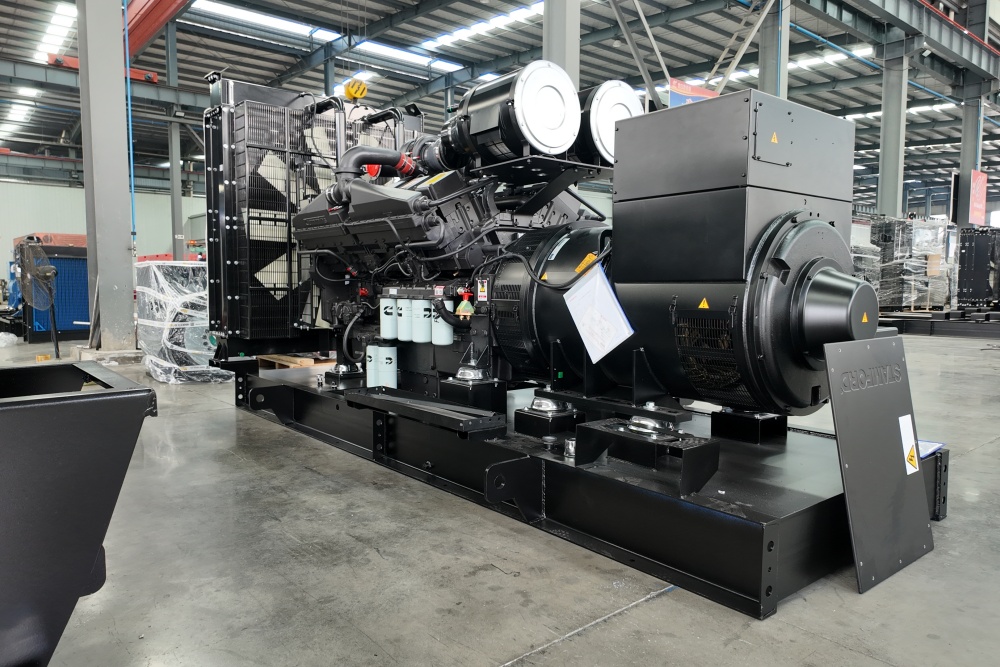

Why a smart manufacturing line is hard on a generator
A line built around servo drives, PLC control and robot welding does not present a smooth load. Each acceleration of a servo axis draws a current spike, each weld draws a step, and the sum of those events is a waveform with a poor shape rather than a steady draw. A set sized only on the connected kilowatts will look adequate on paper and behave badly in the third shift.
Two effects follow. The first is voltage dip, which a servo drive reads as a fault and a PLC may read as a brownout. The second is harmonic distortion, because six-pulse rectifiers in drives and chargers pull non-sinusoidal current through the alternator. Both are governed by the alternator's subtransient reactance as much as by the engine's kW, which is why the plate values behind this article are worth reading in detail.
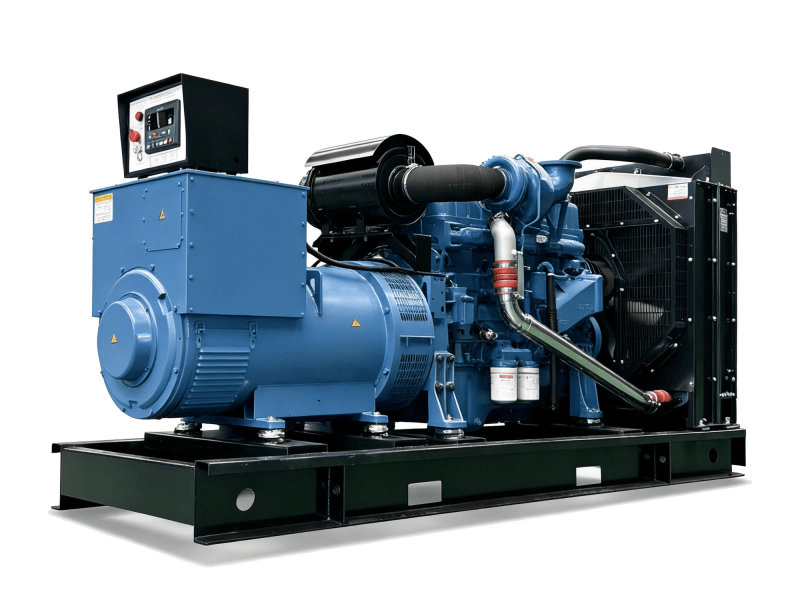
The delivered pair: KC-Y110YY at 137.5 kVA
The dispatch behind this article covers two identical 110 kW sets delivered on 30 October 2026 to a smart equipment manufacturer, recorded under set designations KC-Y110YY and serials B202610001-3 and B202610001-4. The set plate reads 137.5 kVA and 110 kW at 400/230 V, 198 A per phase, 1500 r/min, power factor 0.8, 50 Hz, to GB/T 2820.5-2009, with a mass of 2000 kg.
Buying two units of the same rating in one order is a decision worth examining. It usually means the plant intends either redundancy, with one set on standby for the other, or a split essential panel where each set carries a defined group of loads. Both are reasonable, and both change what the acceptance test should prove.
Engine YC4A190-D30 and the 110 kW set rating
The engine plate is a Yuchai YC4A190-D30 rated 125 kW at 1500 r/min continuous and 138 kW at 1500 r/min standby, with a net mass of 480 kg, standard Q/YCCD 106-2022, emission stage GB 20891 third stage, serial A9H2J1D0474, manufactured 5 August 2026, and a stated genset application of 110 kW continuous and 120 kW standby.
The margin here is 13.6 per cent between the engine's continuous rating and the set's electrical output. For a plant running servo load, that margin is what absorbs the extra fuel demanded during repeated acceleration, and it is the reason a four-cylinder engine of this displacement can hold a 110 kW rating through a shift rather than for an hour.
KCI-110, IP23 and class H at 198 A
The alternator is a KCI-110 at 137.5 kVA, 400/230 V, 198 A, 1500 r/min, 50 Hz, power factor 0.8, IP23, class H insulation, S1 duty, excitation 55 V and 2.8 A, to GB/T 2820.3-2009. Class H is meaningful on a drive-heavy load, because the harmonic currents that a six-pulse rectifier returns to the alternator are dissipated as heat in the windings.
IP23 is the limitation a plant engineer should note. It suits a canopy under shelter and resists falling water at up to 60 degrees from vertical, but it does not tolerate washdown. A machining or food plant that hoses the floor around the set needs a different arrangement, not a higher hope.
The loads a line actually presents
Three loads dominate the sizing conversation. Servo acceleration is a short, repeated surge that the alternator sees as a current step; measurement on similar lines commonly shows peaks of two to three times running current for a fraction of a second. Robot welding is a larger, less frequent step. And the drives' rectifiers generate fifth and seventh harmonic currents that add heat without adding useful torque.
The practical answer is not a bigger set alone. An alternator with lower subtransient reactance, a line reactor ahead of the drives, and a sequenced start so that welders cannot strike while three axes accelerate together will together do more for power quality than adding 40 kW of capacity.
Two sets, one panel: the redundancy arithmetic
With two 110 kW sets, a common arrangement is a main and a standby with an automatic transfer between them, rather than a parallel bus. Parallel operation needs synchronising controls, matching governor behaviour and a load-sharing scheme, and it is rarely justified at this size. Sequential duty is simpler and easier to prove during commissioning.
A sequential scheme also defines the failure mode in a way a parallel bus does not. If one set fails to start, the other carries the essential panel rather than being dragged down by a synchronised load, and the site stays up on a reduced supply. That behaviour is worth writing into the changeover logic: one set with a defined load list beats two sets sharing everything.
Fuel and autonomy across a two-shift plant
At 110 kW and 70 per cent load, a set of this class consumes roughly 20 to 24 litres per hour. Two shifts of sixteen hours therefore need about 350 litres, and a 500 litre tank gives a day plus a reserve, which is the usual compromise between capital cost and refuelling logistics.
The detail that catches plants out is the fuel path, not the tank. A line that stops mid-cycle because a set flamed out on air drawn through a loose suction line loses more than the fuel cost. A day tank at the set, a transfer pump from bulk storage, and a water separator with a drain schedule remove most of that risk.
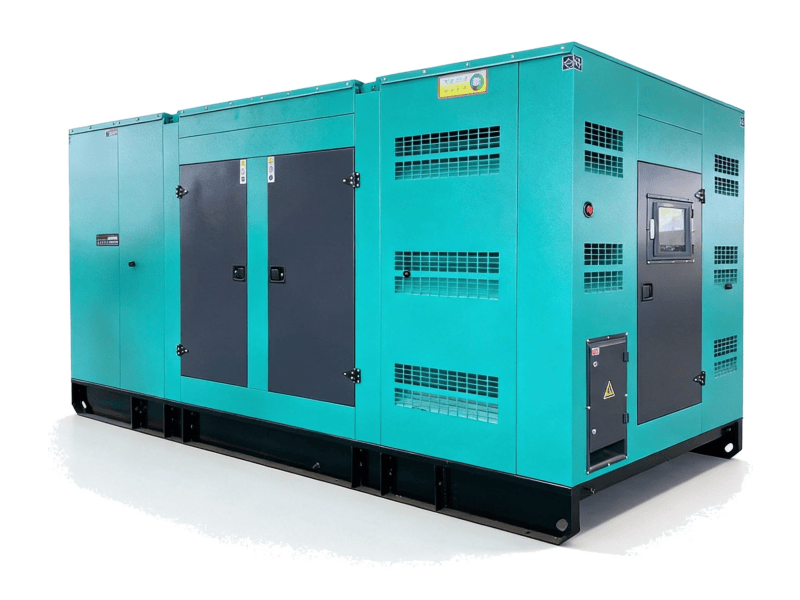
Enclosure, airflow and the 2000 kg footprint
The 2000 kg set mass and the canopy dimensions decide the civil work. A set of this size needs a level concrete pad, a clear path for a pallet truck or a forklift, and louvre faces that are not starved of air or recirculating their own exhaust. Installing a 110 kW canopy with its discharge facing a wall raises both intake temperature and measured noise, and neither is visible on a drawing.
Documentation and the tests worth specifying
For a line-support set, the factory record should show the four-step load test at 20, 50, 75 and 100 per cent, and preferably a run with a representative drive load rather than resistive load only. Harmonic behaviour and voltage dip under a step are what the plant will actually experience, and a resistive test alone does not reveal them.
Jiangsu Kaichen Electric Power Equipment Co., Ltd. has built sets since 2013 with stated annual capacity of 8000 units and over 20000 delivered in three years, holding ISO 9001, ISO 14001 and ISO 45001 certification, CE Machinery Directive conformity and OEM authorisation. Terms are FOB Shanghai, 30 per cent deposit, balance before shipment, and single units ship in 7 to 15 working days. Enquiries: cnkcpower@gmail.com.