
What 200 kW actually covers in an industrial backup role
A 200 kW standby set is usually bought for one of two situations: protecting a production line against short utility interruptions, or carrying essential services in a plant where a full-load standby would be disproportionate. Both cases put a premium on transfer speed and on the set being genuinely ready rather than nominally installed. A standby machine that has not run under load for six months is a liability that is only discovered during the event it was bought for.
The delivered unit: KC-S200YY
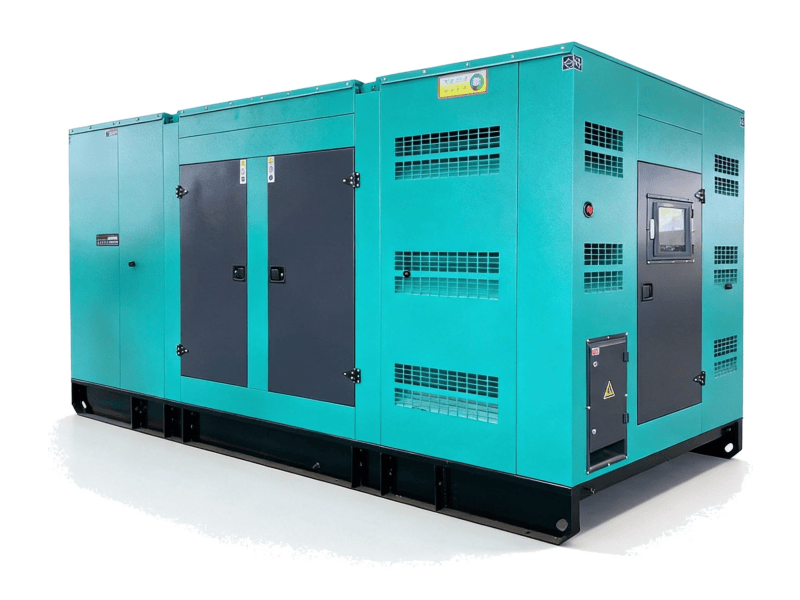
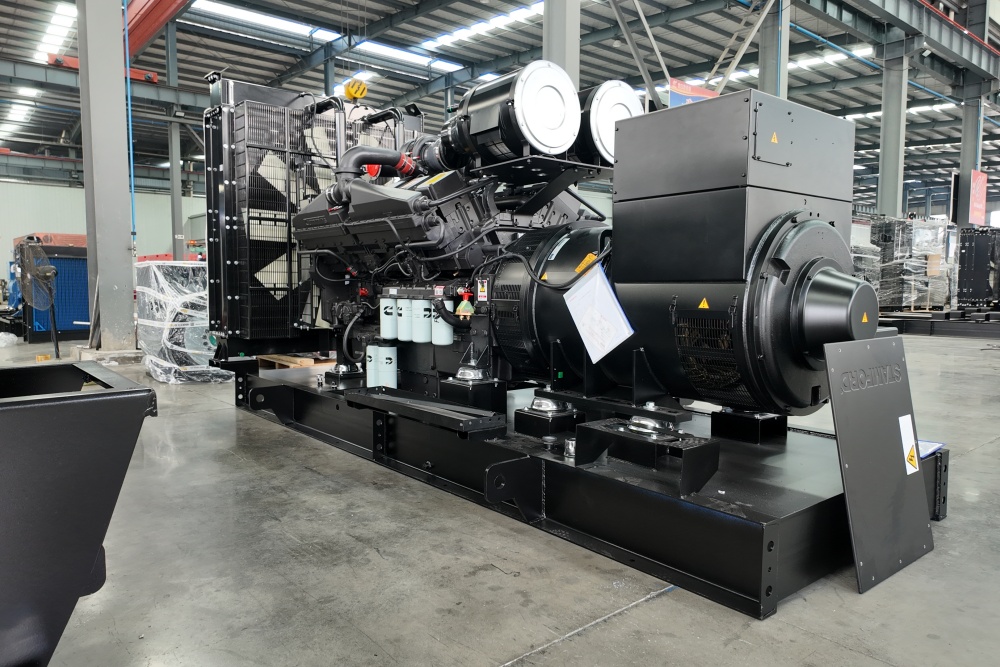
The consignment behind this article left Jiangsu Kaichen on 29 October 2026 for a power equipment company. The unit is a soundproof set, model KC-S200YY, rated 250 kVA and 200 kW at 0.8 power factor, three-phase at 400/230 V, with a rated current of 360 A, 50 Hz, 1500 r/min, and a complete set mass of 3500 kg.
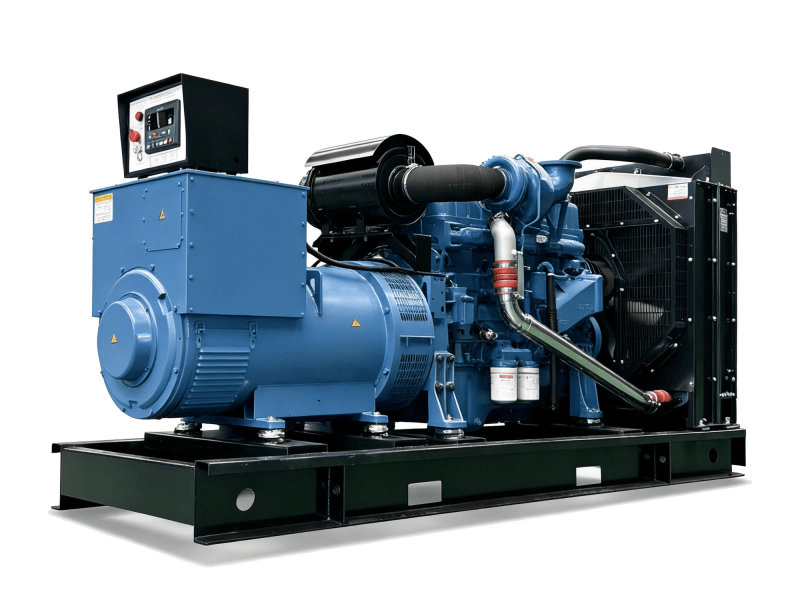
The 3500 kg mass is worth comparing with the 2400 kg of a 200 kW open or lightly canopied set. The difference is the enclosure: heavier gauge panelling, a lined acoustic module, a larger attenuating base frame and the structural provision for lifting. Buyers who compare canopy weights across suppliers should check whether the figure includes the acoustic lining and the base frame, because a 200 kW canopy set quoted at 2400 kg is usually a different acoustic specification.
Alternator, controller and the transfer path
The alternator is a Kaichen KCI-200 rated 250 kVA at 360 A, IP23 with class H insulation and S1 duty to GB/T 2820.3-2009. The margin between the 250 kVA alternator rating and the 200 kW set rating provides thermal headroom for the motor loads that dominate industrial essential-supply panels.
The transfer arrangement is where most standby installations succeed or fail. An automatic transfer switch that is rated for the full load current, mechanically interlocked against back-feeding, and tested with the actual downstream load is worth more than a higher-specification generator. The controller's mains-failure sensing point should be upstream of the transfer switch, so the set starts on a genuine supply loss rather than on a downstream breaker trip.
Test regime: the part that decides whether the set works in year three
Jiangsu Kaichen's factory routine for sets of this class is a four-step load sequence at 20, 50, 75 and 100 per cent of rated output, with voltage, frequency, exhaust temperature and oil pressure recorded at each step and a video record issued with the documentation. The purpose is not certification theatre; it is a baseline that a maintenance team can compare against in later years.
On a standby set, the on-site regime should mirror that logic at lower frequency. A monthly no-load start of twenty minutes, a quarterly run at 50 per cent load for an hour, and an annual full-load test of at least two hours are the intervals most maintenance plans converge on. The annual full-load run is the one that exposes a weak injector, a slipping belt or a fouled radiator before those become an outage.
Fuel storage, polishing and the water problem
Standby sets are the classic victims of fuel neglect, because their tanks sit still for months. Diesel stored in a part-filled tank accumulates water at the low point and supports microbial growth at the fuel-water interface, and the resulting filter blockage typically appears during the first sustained run after a long idle period.
Three measures address this without much cost. Keep the tank above two-thirds full where possible, fit a water trap and drain point at the lowest corner, and schedule a fuel polish that circulates the contents through a filter rather than simply topping up. Where local fuel quality is variable, a pre-filter with a transparent bowl makes the problem visible before it becomes a shutdown.
Enclosure acoustics on an industrial site
The acoustic target for this enclosure class is 72 dB(A) at 7 m, which is a working figure rather than an absolute claim, and it depends on installation. A set standing against a reflective wall or inside a plant room with hard surfaces will read higher than the same set on an open pad. Where the plant has an occupied area within that radius, the two decisions that matter are the siting of the louvre face and the routing of the exhaust outlet away from the occupied side.
Vibration isolation is the companion measure. A soundproof set on a rigid concrete pad transmits less than one on a flexible surface, and resilient mounts between the base frame and the pad reduce structure-borne noise without affecting the set's mechanical stability if they are correctly sized for the 3500 kg mass.
Load profile: what a 200 kW essential panel really draws
Essential-supply panels are usually a mixed load: pumps, fans, compressors, control systems and lighting, each with a different starting characteristic. The generator's 360 A per phase rating sets the steady-state envelope, and the starting constraint is set by the largest motor that can be switched while the rest of the panel is live.
The practical step is to measure rather than estimate. A recording on the essential panel over a normal week gives the peak demand, the load steps and the duration of each; that record is the basis for deciding whether 200 kW is adequate or whether the load should be split across two supplies. Where the panel includes a large chiller or compressor, a soft starter or a variable-speed drive often reduces the required generator rating more than any generator option.
Documentation and spares for a long-lived standby asset
A standby set may run for twenty years with perhaps a few hundred hours of use, so the asset value sits in the documentation and the spares policy rather than in the running hours. Buyers should retain the nameplate photographs, the factory load-test record, the wiring diagram, the controller manual and a schedule of the consumable part numbers. A maintenance team that can order the correct filter from a part number wastes far less time than one that has to measure a housing.
Why Jiangsu Kaichen for industrial standby sets
Jiangsu Kaichen Electric Power Equipment Co., Ltd. has been manufacturing generating sets since 2013, with stated annual capacity of 8000 units and more than 20000 sets delivered in the last three years. Certifications include ISO 9001, ISO 14001 and ISO 45001, CE Machinery Directive conformity and OEM authorisation for the engine brands it assembles, and the company covers engine platforms from Cummins and Yuchai to SDEC, Weichai, Perkins and Volvo within a 20 to 2000 kVA range.
Terms are FOB Shanghai with 30 per cent T/T deposit and the balance before shipment, standard lead time 7 to 15 working days, and container quantities 20 to 30 days, shipping from Shanghai or Nanjing. Enquiries: cnkcpower@gmail.com, WhatsApp +86 180 1234 1322.