
When a construction site genuinely needs 640 kW
Construction loads are volatile in a way that process plant loads are not. A tower crane, a welding bank, batch plant motors and site lighting do not share a smooth daily curve; they stack into peaks that can exceed twice the average demand for minutes at a time. Sizing a site generator therefore starts from the peak sequence rather than the connected total, and 640 kW is a rating that appears when a project runs crane operations, a batching plant and a fabrication area on one supply.
The second driver is duration. A site that expects a two-hour outage needs a standby rating; a site where the utility connection is months away needs prime power, which means the set runs as the primary source and the rating has to hold for thousands of hours rather than dozens.
The delivered unit: KC-SC640M on a construction project
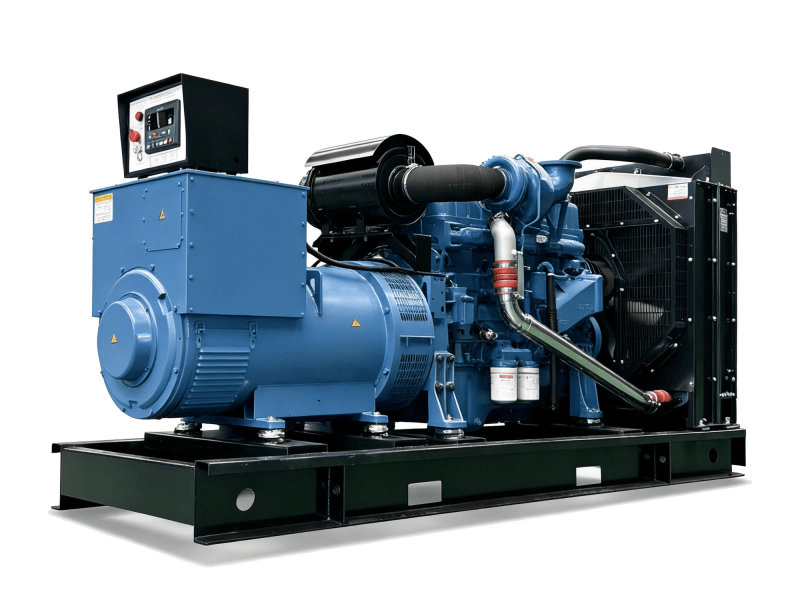
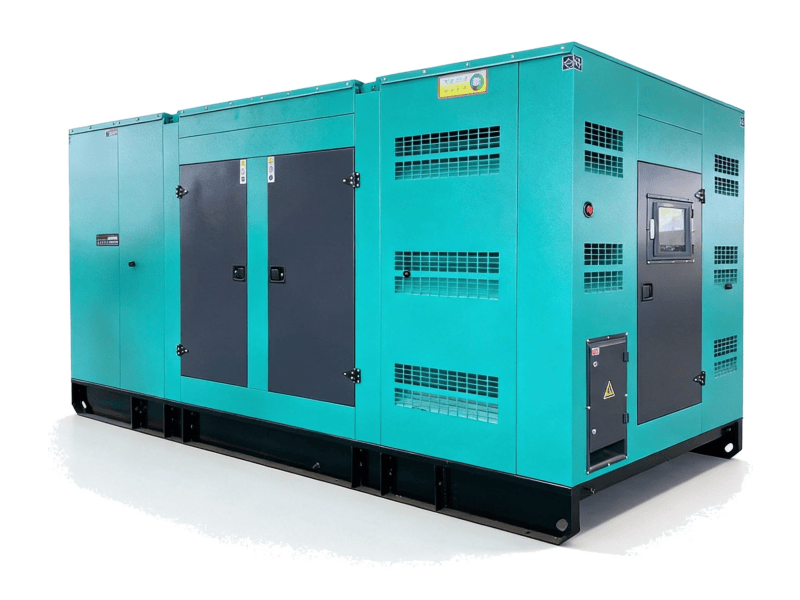
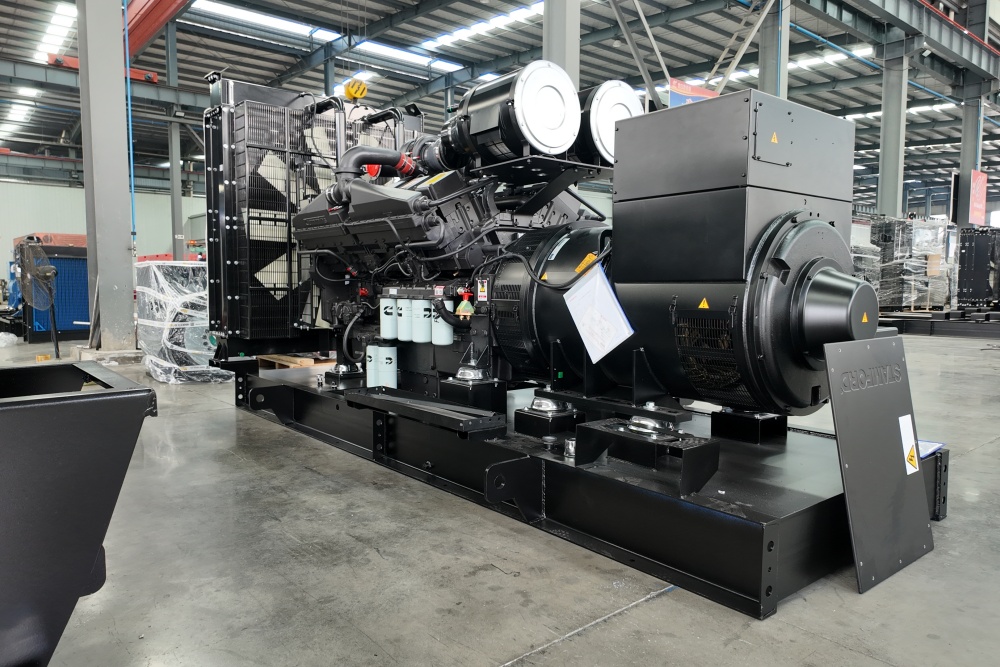
The consignment behind this article left Jiangsu Kaichen on 30 October 2026 for a construction company's project site in Yixing, Jiangsu. The unit is a containerised set, model KC-SC640M, rated 800 kVA and 640 kW at 0.8 power factor, three-phase at 400/230 V, with a rated current of 1152 A, 50 Hz, 1500 r/min, and a complete set mass of 8000 kg.
Eight tonnes is the figure that governs everything downstream: the crane capacity needed at both ends of the journey, the load-bearing capacity of the pad, the size of the lifting frame inside the container, and the route survey for bridges and site roads. A buyer who fixes the rating before confirming crane and access capacity often discovers the constraint too late to change the enclosure format.
Engine provenance and what the certificate tells you
The engine is a Shanghai Diesel 6KTAA25-G32. The engine certificate in the documentation records a production order of 8121029, a serial number K9269001822 and an issue date of September 2026, with the code K0112 against the model. That level of traceability is what allows a warranty claim to be assessed on facts rather than on recollection, and it is one of the practical differences between a documented build and an assembled one.
The alternator is a Kaichen KCI-640 rated 800 kVA at 1152 A, IP23 with class H insulation, matched to the engine through a single-bearing coupling on a common base frame. On a 640 kW machine the coupling alignment and the base frame stiffness are the details that determine whether vibration stays within limits at full load.
What the container format changes
A containerised set is not simply a generator inside a box. The format changes transport, access, ventilation and cable entry in ways that are worth planning before the unit is built. On transport, an 8000 kg set in a container-sized envelope can travel as a conventional container load, which simplifies shipping documentation and road permits compared with an open skid of the same rating.
On ventilation, the container relies on louvred panels sized for the combustion air and the radiator airflow at rated load; a set installed with its outlet facing a wall or another container will recirculate hot air and derate within an hour. On cable entry, the 1152 A output means a substantial cable or busbar termination, and the entry point should be planned with the site's distribution design rather than decided on the day of commissioning.
On access, the container's doors and internal layout determine whether a filter change is a ten-minute job or a two-hour one. Buyers should ask for the internal arrangement drawing, not only the external envelope dimensions.
Load sequencing at 640 kW
At 1152 A per phase, the set has real capacity, but it will not absorb unrestricted simultaneous starting of a crane hoist and a batching plant. The practical method is to list every load that can start within the same minute, convert each to a starting kVA multiple, and then sequence the largest consumers with interlocks at the distribution board.
For a construction site, three interlocks do most of the work: crane hoist against batching plant start, welding bank against crane travel, and site lighting energisation staged rather than simultaneous. Each of these is a wiring decision taken at the panel, and each is cheaper than the next rating step on the generator.
Fuel autonomy and the site's refuelling plan
A 640 kW set at 75 per cent load will consume fuel in the region of 100 to 120 litres per hour depending on the engine's specific consumption, which means a day tank is a few hours and a bulk tank is a logistics commitment. On a site where the set is prime power, fuel supply becomes a scheduled operation with a defined minimum level, not a task for whoever notices the gauge first.
Fuel quality control is also a site-management issue. Water and particulate accumulate faster in a tank that is drawn down and refilled repeatedly, and the injection system on a 25-litre class engine is less forgiving than the numbers suggest. A settling tank, a water trap at the low point and a scheduled drain interval are the standard measures.
Noise, exhaust and the neighbours
Construction sites are frequently close to occupied buildings, and a containerised 640 kW set running through the night is a different acoustic problem from a standby set that runs twice a year. The enclosure attenuates mechanically, but the exhaust outlet and the louvre face are the two paths that still carry. Routing the exhaust away from the nearest facade and turning the louvre face toward the site interior rather than the boundary does more than adding absorbent material inside the container.
Three site-specific checks are worth adding. Verify the changeover sequence with the site's actual distribution arrangement. Verify fuel supply at the tank's low-level mark with the set at load. Verify that the container's ventilation maintains coolant temperature at rated output on the hottest forecast day of the project period.
Why Jiangsu Kaichen for containerised prime power
Jiangsu Kaichen Electric Power Equipment Co., Ltd. has manufactured generator sets since 2013, with stated annual capacity of 8000 units and more than 20000 sets delivered in the last three years. The company's certification set covers ISO 9001, ISO 14001 and ISO 45001, CE Machinery Directive conformity and OEM authorisation for the engines it assembles, and its containerised range is offered from 500 to 2500 kVA.
Commercial terms are FOB Shanghai, 30 per cent T/T deposit and the balance before shipment, with 7 to 15 working days standard lead time and 20 to 30 days for container quantities. Shipment can be arranged from Shanghai or Nanjing, and enquiries go to cnkcpower@gmail.com or WhatsApp +86 180 1234 1322.